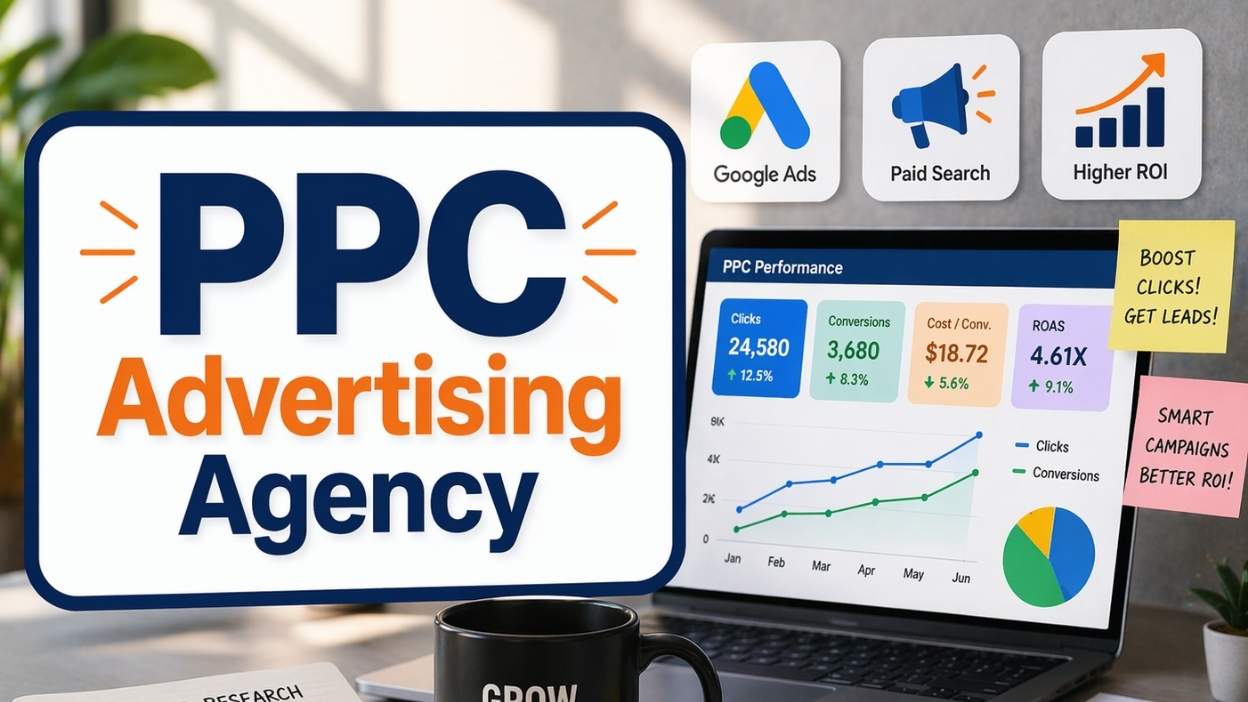

Picking a PPC agency used to sound simple. Find someone who runs Google Ads, hand over the budget, and wait for leads.
Then reality shows up.
The clicks come in. The invoices come in faster. The leads look busy but not useful. Your dashboard smiles at you, but sales does not. At that point, choosing an agency stops feeling like marketing and starts feeling like detective work.
That is why this guide matters.
If you want better results in 2026, you need more than a vendor who knows where the “Create Campaign” button lives. You need a team that understands intent, measurement, landing pages, automation, and business goals. Google’s own documentation keeps pointing to the same foundations: relevant ads, strong landing pages, reliable conversion tracking, and helpful content built for people, not search tricks.
This article explains how to choose the right PPC advertising agency, what questions to ask, what red flags to avoid, and how to compare Adyorbit vs different PPC agency options in a smart, white-hat way.
Why choosing the right PPC agency matters more in 2026
PPC in 2026 is not just about bidding on keywords. Google Ads now uses automation and auction-time signals such as device, location, time of day, language, and operating system to help optimize for conversions or conversion value. That gives advertisers more power, but it also raises the bar for strategy. A weak setup can waste money faster than ever.
A strong agency should know how to guide that automation instead of blindly trusting it.
That means they should know how to:
- choose the right bid strategy
- set up clean conversion tracking
- improve landing page experience
- write relevant ads
- review search intent
- use first-party data carefully
- connect campaign performance to real business results
If they only talk about impressions, clicks, or “brand visibility,” pause for a second. Visibility is nice. Revenue is nicer.
Start with your own goal before you compare agencies
Before you hire any PPC advertising agency, define what success actually means for your business.
A lot of companies skip this step. Then they end up with reports full of activity but no clarity.
Your goal might be:
- more qualified leads
- more demo bookings
- lower cost per acquisition
- higher return on ad spend
- stronger lead quality
- more calls from high-intent buyers
- more ecommerce purchases
Google Ads lets you optimize for different outcomes, including clicks, impressions, conversions, and conversion value. So if your goal is vague, your campaign usually becomes vague too.
A good agency will ask this early. A bad one will skip straight to package pricing.
What a good PPC advertising agency should actually do
A proper agency does more than launch ads. It should work across the full chain of performance.
1. Build campaigns around search intent
Google explains that Quality Score depends partly on ad relevance, which means the ad should closely match the intent behind the search.
That matters because not every keyword has the same commercial value.
For example:
- “what is PPC advertising” is educational
- “best PPC advertising agency near me” is commercial
- “hire PPC agency for ecommerce” is high intent
A strong agency groups campaigns by intent, not just by broad theme. That makes ad copy sharper, landing pages more relevant, and budgets easier to control.
2. Improve landing page experience
Google says landing page experience is one of the three Quality Score components, along with expected CTR and ad relevance. Google also continues to highlight landing page usefulness as a major performance factor.
So yes, your agency should care about the page after the click.
If your ad promises a free audit but sends people to a generic homepage with three popups and no clear next step, the problem is not the audience. The problem is the experience.
A strong agency should review:
- message match
- page speed
- mobile usability
- CTA clarity
- form length
- trust signals
- offer relevance
A click is not a conversion. It is just an expensive maybe.
3. Set up real conversion tracking
Google’s conversion measurement documentation is very clear. Businesses should define valuable actions, create conversion actions, and use those measurements to refine campaigns. Google also supports multiple conversion actions, because not all conversions are equal.
That means a serious agency should track more than page visits.
Useful conversions can include:
- purchases
- qualified lead forms
- phone calls
- booked meetings
- quote requests
- button clicks
- specific page actions
Google also notes that enhanced conversions can improve measurement accuracy and support stronger bidding performance by using privacy-safe hashed first-party data.
So when an agency says “we optimize for results,” ask one simple question.
Which results?
If they cannot answer that clearly, keep moving.
4. Use automation with human judgment
Google’s Smart Bidding uses auction-time bidding and many real-time signals to optimize for conversions or conversion value. Smart creative systems also use AI to match messages to customers.
That is useful. It is not permission to stop thinking.
The best PPC agencies know when to lean on automation and when to step in. They still review search terms. They still improve creative. They still refine the landing page. They still ask whether the leads are actually good.
Automation works best when the inputs are clean. Garbage in still produces garbage out. It just does it at machine speed.
How to judge an agency before you hire them
Here are the main things to check.
Strategy clarity
Ask them how they build campaigns.
A real agency should explain:
- keyword grouping
- match types
- negative keyword use
- landing page mapping
- bidding logic
- testing process
- reporting structure
If the answer sounds like “we optimize everything with AI,” that is not a strategy. That is a slogan with Wi-Fi.
Reporting quality
Your agency reports should connect ad spend to business outcomes.
Good reports include:
- cost per lead
- cost per acquisition
- conversion rate
- conversion volume
- return on ad spend
- search term insights
- landing page performance
- trend changes over time
Google’s documentation around conversion actions and bidding goals makes this especially important. If you optimize for conversions, your reporting should reflect conversions in a meaningful way.
Content and brand understanding
Google Search guidance still recommends using the words people use to search, placing them in important page locations, and creating helpful, reliable, people-first content. Google also says AI-generated content is not automatically a problem, but content should still be useful and aligned with its long-standing quality principles.
That matters because PPC and SEO are no longer separate islands.
A smart agency should understand:
- search language
- offer positioning
- landing page messaging
- user concerns
- page relevance
- trust building
In other words, they should understand marketing, not just ad controls.
Red flags that should make you nervous
Some warning signs are classic. Some now wear modern clothes.
Watch for these:
They promise guaranteed rankings or instant ROI
No agency controls the auction completely. Google uses many factors, including bid strategy, relevance, landing page experience, and auction-time signals. Anyone selling certainty is selling fantasy.
They avoid talking about conversion tracking
That usually means one of two things. They do not understand it well enough, or they do not want you to look too closely. Neither option is comforting.
They focus only on clicks
Clicks matter. But if your cost per lead is terrible and your sales team hates the leads, the click chart is just colorful disappointment.
They never mention landing pages
Google mentions landing page experience constantly for a reason. Agencies that ignore it are leaving performance on the table.
They use the same pitch for every business
A real strategy should fit your business model, offer, sales process, and audience. Cookie-cutter campaigns often produce cookie-cutter results. Unfortunately, those results are usually crumbs.
Questions to ask before signing with any PPC agency
Ask these directly.
- How do you define success for this account?
- Which conversions will you track?
- How will you improve landing page performance?
- What bid strategies do you usually use and why?
- How often do you review search terms and negative keywords?
- How do you report lead quality, not just lead quantity?
- What access will I have to the ad account and data?
- How do you handle testing?
- How do you use automation without losing control?
- What changes would you make in the first 30 days?
A serious agency will answer clearly. A shaky one will start performing verbal gymnastics.
Adyorbit vs Different PPC Agency
I cannot verify Adyorbit is internal process from public source material alone, so the table below works best as a positioning framework you can use for your page content or brand messaging.
| Factor | Adyorbit positioning | Different PPC agency |
|---|---|---|
| Strategy approach | Custom strategy based on business goals and intent | Often uses a standard setup for all accounts |
| Keyword planning | Focuses on high-intent and relevant keywords | May chase broad keywords for more traffic |
| Landing page thinking | Reviews message match and conversion path | Often stops at ad setup |
| Conversion tracking | Prioritizes meaningful business actions | May track only basic form fills or clicks |
| Reporting style | Connects spend with leads, CPA, and ROI | May highlight clicks and impressions first |
| Automation use | Uses AI tools with human review | May rely too much on default automation |
| Communication | Strategic and consultative | Reactive and report-heavy |
| Fit for growth | Built for long-term performance | Can become inconsistent as spend grows |
You can adjust that table to match Adyorbit’s real service offer. Just keep it honest. White-hat content works better when the claims can survive scrutiny.
What the best agency relationship looks like
A strong PPC agency should feel like a thinking partner, not a monthly PDF sender.
You should expect them to:
- explain what they are doing
- connect paid traffic to business goals
- suggest landing page improvements
- show where spend is working
- flag wasted spend early
- talk openly about testing and failures
- adapt as your market changes
Google’s guidance keeps reinforcing a simple idea: better results come from relevance, usefulness, good measurement, and content built for people first. That applies to ads just as much as pages.
Final thoughts
If you want to choose the right PPC advertising agency in 2026, do not start with who sounds the loudest. Start with who thinks the clearest.
Look for a team that understands search intent, values conversion tracking, respects landing page quality, and uses automation with discipline. Look for an agency that can explain its strategy in plain English. Look for one that cares about business results more than pretty charts.
That is how you protect your budget.
That is how you build trust.
And that is how you find an agency that can actually help you grow instead of just helping your ad platform stay busy.